

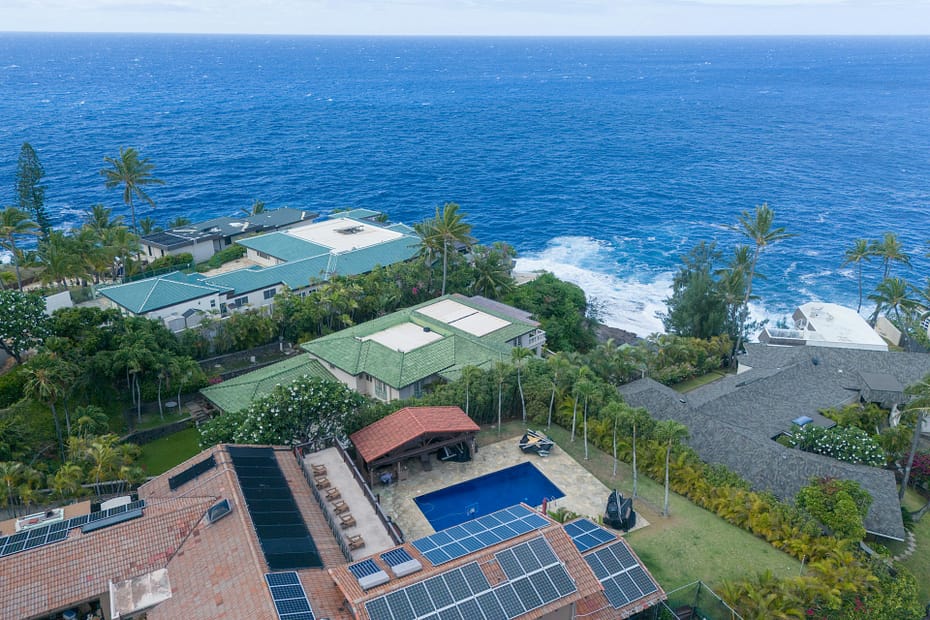
Photo by Diwei Zhu on Unsplash
Starting January 1, 2027, Hawaii’s solar tax credit is still around. Technically, that’s good news. But here’s what should actually catch your attention: the credit becomes a lot less predictable, and in some cases, you might not know your exact credit amount until months after you’ve already paid for your system.
That’s a very different situation than what homeowners have dealt with in the past. Here’s what’s changing, why the biggest change is riskier than it sounds, and why 2026 is shaping up to be a much safer year to install than 2027.
The Changes at a Glance
Before getting into the details, here’s the short version of what’s coming:
- The homeowner credit rate stays at 35%, capped at $5,000 per system
- A new $40 million statewide cap on total credits begins in 2027 and runs through 2030
- New income limits kick in: $175,000 for single filers, $350,000 for married couples filing jointly
- Homeowners will need advance certification from the Hawaii State Energy Office before they can claim the credit
- There’s a strict annual application window, with certified credit amounts expected by May 31
- The federal residential solar tax credit is already gone
Each of these matters, but one of them is a bigger deal than the rest.
The $40 Million Cap: Why This Is the Riskiest Change
Worth noting: starting in 2027, Hawaii caps total statewide solar tax credits at $40 million per year. If homeowners statewide apply for more credit than that $40 million covers, the money doesn’t stretch to cover everyone in full. It’s divided proportionally among everyone who qualifies.
Think about what that actually means. Two homeowners could install identical $30,000 solar systems in 2027, both do everything right, and still end up with completely different credit amounts, not because of anything they did, but because of how many other people in Hawaii happened to apply that same year. One homeowner might get close to the full $5,000. Another might get a few hundred dollars. It genuinely depends on statewide demand that no individual homeowner has any control over.
That’s what turns a fixed, dependable incentive into something closer to a lottery. You can’t plan your budget around it. You can’t tell your lender exactly what to expect. You’re committing tens of thousands of dollars to a system now, based on a credit amount you won’t actually know until the following spring.
New Income Limits
Starting with tax years after December 31, 2026, there’s also an income ceiling on who can even claim the credit. If your adjusted gross income is above $175,000 as a single filer, or $350,000 filing jointly, you won’t qualify at all, no proration, no partial credit, nothing. The law’s language is broad, and may apply to more than just standard homeowner installs, so more guidance is expected as the state works out exactly how this gets applied.
The New Certification Process (and Why It Adds Even More Uncertainty)
On top of the funding cap and income limits, the process itself is changing. In the past, you could install your system and simply claim the credit using Form N-342 with your tax return. Starting in 2027, that’s not enough.
Instead, you’ll need to submit a certified statement to the Hawaii State Energy Office listing your income, your system’s actual cost, and the credit amount you’re claiming. Before issuing you a certificate, the Energy Office has to certify that you and your system qualify and that certificate must be filed with your tax return.
In plain terms: there’s now a waiting period and a stack of paperwork between installing your system and knowing what you’ll actually get back.
The Application Deadline
The state is expected to set an annual application window, closing March 1 at 5:00 PM Hawaii Standard Time. Certified credit amounts are expected to go out by May 31. The opening date for applications hasn’t been set yet, and final guidance is still pending, which means even the process itself carries some uncertainty right now.
The Bigger Picture: 2025 vs. 2027
Here’s what this looks like in real numbers. Say you install a $30,000 homeowner-owned solar system.
In 2025, you’d combine a $9,000 federal tax credit with a $5,000 Hawaii credit, for $14,000 back total.
In 2027, there’s no federal credit at all. Your Hawaii credit could reach $5,000, but statewide demand may prorate it down toward $0. The exact amount depends on your eligibility, your income, how many other people applied that year, and the certificate the Hawaii State Energy Office ultimately issues.
That’s the real difference between installing in 2025 and installing in 2027. And it’s exactly why the timing question matters so much right now.
Why 2026 Is a Different Story
Governor Green’s Executive Order 26-02 protects 2026 systems from the new $40 million cap and income limits. If you can show you decided to go solar before Act 24 was signed on May 21, 2026, you still qualify for the full, guaranteed 35% credit, up to $5,000, on a 2026 installation. None of the proration risk. None of the new certification wait. Just the straightforward process homeowners have relied on for years.
That’s a meaningful window, and it’s closing. If you’ve been thinking about going solar, this is the year where the math is still predictable.
Key Takeaways
2027 brings real, structural uncertainty to Hawaii’s solar tax credit, especially the $40 million cap, which could shrink your credit without warning and without anything you did wrong. Installing in 2026 still gets you the full, guaranteed credit under the current rules. If solar has been on your radar, the timing of your decision has never mattered more than it does right now.
Frequently Asked Questions
Will I still get the full $5,000 Hawaii solar tax credit in 2027? Possibly, but it’s no longer guaranteed. If statewide applications exceed the new $40 million cap, your credit will be reduced proportionally, and you won’t know your final amount until your certificate is issued.
What is the $40 million cap and how does proration work? Starting in 2027, Hawaii can approve no more than $40 million in total RETITC credits per year. If total statewide demand exceeds that amount, the available funds are split proportionally among qualifying applicants, meaning your actual credit could be less than the full calculated amount.
Do the new income limits apply to me? If your adjusted gross income exceeds $175,000 as a single filer or $350,000 filing jointly, you won’t qualify for the credit starting with tax years after December 31, 2026.
Is it too late to install solar and qualify under the old rules? Not yet. Systems placed in service during 2026 are protected from the new cap and income limits under Executive Order 26-02, as long as you can show your decision was made before May 21, 2026.
What happened to the federal solar tax credit? The federal Residential Clean Energy Credit is no longer available for homeowner-owned systems installed going forward, which is part of why the timing of your Hawaii installation matters more than ever.
Don’t leave your solar savings up to chance. Talk to Independent Energy Hawaii today about locking in your installation before the 2026 window closes.